/eh/2025-01-08/173633966714069467/picture.png)

/eh/2024-12-24/173503345348979036/Favorite-Icon.png)
/eh/2025-07-08/1751962110204480194/picture.png)
/eh/2025-06-21/1750485478958537574/countryInfoIcon.png)
/eh/2025-06-21/1750485741321434291/Hi-Sign-in-My-Nihao.png)
/eh/2025-06-21/1750485837193896318/cart.png)
/eh/2025-06-21/1750485968202533847/cart.png)
/eh/2025-04-17/1744862476612819675/hot-img.png)
/eh/2025-11-07/1762504524550532584/header-icon.jpg)
/eh/2025-07-07/1751875582852206790/header-icon.png)
/eh/2025-07-07/1751875587886277738/header-icon.png)

Best in 7 days


Shopping security

Above: Front of the Specimen Card
Oreodonts were short mammals with heavy bodies, long tails, and hoof-like toes. Their name means “mountain teeth” and the sharp ridges of their molars were ideal for grinding the diverse foliage of grassy prairies as well as roots and shoots in wooded areas.
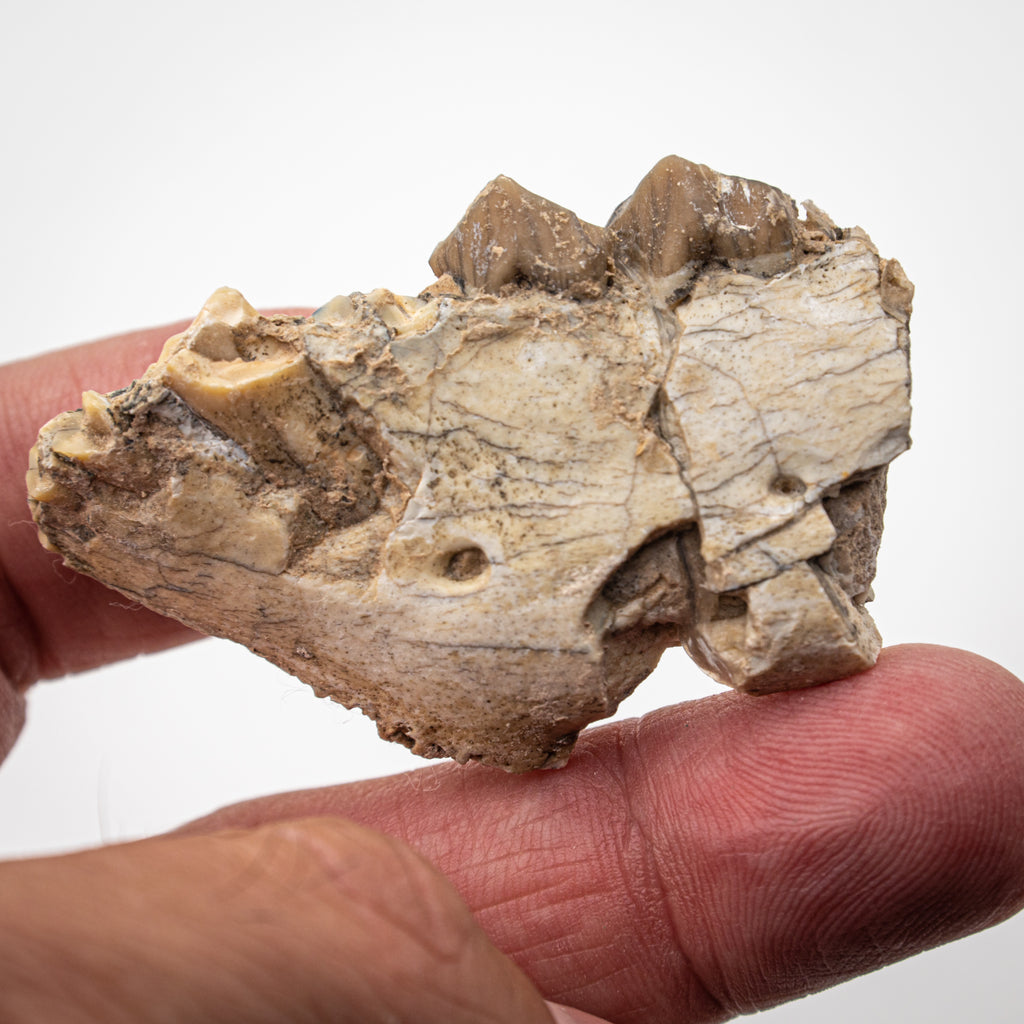
Above: Medium size specimen in-hand.
This specimen is a single jaw fragment from Merycoidodon culbertsoni, a species of oreodont found in enormous herds across North America for over 30 million years.

Above: Medium (top) and Small (bottom) Specimens together.
Oreodont Jaw Sizing:
Please Note: The fragments vary widely in size and shape. All jaw fragments include embedded teeth though the number and condition may vary.
Due to the variability of this specimen, we've opted to ship all jaw fragments in sturdy cartons rather than our glass-topped riker display cases. As with other specimens, a small information card is included that also serves as the certificate of authenticity.

Above: Small size specimen in-hand.
More About Oreodonts

Above: A colorized version of Robert Bruce Horsfall's classic 1913 Merycoidodon culbertsoni Illustration (Source: Mini Museum).
At the end of the Eocene, Earth’s ecosystems began to change. A shift in climate and a decline in tropical zones brought about expansive plains and grasslands, new ecosystems that would be home to never before seen flora and fauna. The Oreodonts, a family of small sheep-like artiodactyl, took full advantage of this change and appeared on the plains and forests of North America where they thrived in the new world for millions of years.
The oreodont, sometimes called the ruminating hog, was a short mammal with a heavy body, a long tail, and a hoof-like set of toes. Their name means “mountain teeth,” remarking on the ridge structures of their molars. These flattened teeth indicate a browser’s diet, searching through grassy prairies and wooded areas for roots, shoots, and other plant matter.
Based on their shape, it was first believed that these creatures were related to modern-day pigs. New science suggests this is a case of convergent evolution rather than familial relation. In truth, the oreodont’s closest relative today is the camel, though even this is quite distant.

Above: Merycoidodon culbertsoni (Source: NMNH Paleobiology Department).
These teeth come from the Merycoidodon culbertsoni, a species of oredont that could be found all over North America between 46 and 16 million years ago. Merycoidodon grew to be around 4-5 feet long and walked the plains on short, stubby legs. Like other oreodonts, they had flat molars that tore and ground tough plant matter. These teeth were a vital adaptation to survival in the prehistoric grasslands as without their specialized function the Merycoidodon’s diet would have been impossible. Strangely, the species also had very powerful and long canine teeth alongside their molars, though the use of those teeth isn’t as understood.

Above: Medium and Small Specimens together.
Merycoidodon wasn’t the only successful member of its family though, as oreodonts adapted to their surroundings in a number of unique ways. Species varied from cat-sized desert dwellers, cow-like herd animals, and massive semi-aquatic beasts. Strangest of all was Brachycrus, a unique branch that evolved a specialized trunk to scrounge for food much like the modern tapir. Though they were only distantly related to Cervidae, one could compare the two families by their large amount of specialization and variance between species.
Most Oreodont species lived in large herds, judging from the close proximity of mass mortalities in fossil beds. It’s likely this would have helped protect them from predators of the time, like the Nimravid, a muscular feline-like hunter.
This particular genus, Merycoidodon, lasted over 30 million years, a very impressive span given that the average mammalian species normally survives 1-2 million years. What ultimately did in the creatures was a snowball of circumstances; reduced food sources led many oreodonts to starvation and those that survived lived in weaker herds allowing for over-predation. All of these factors stemmed from one thing though: a radical change in climate that made the world unsuitable for the oreodont.
Further Reading
Bader, Robert S. “Variability and Evolutionary Rate in the Oreodonts.” Evolution, vol. 9, no. 2, 1955, pp. 119–140.
Thorpe, Malcolm Rutherford. “The Geological History of the Oreodonts.” Journal of Mammalogy, vol. 6, no. 2, 1925, pp. 69–82.
“Oreodont: Ancient Grazer of the Badlands (U.S. National Park Service).” National Parks Service, U.S. Department of the Interior, 10 Nov. 2020

Above: Back of the Specimen Card
Ships within 48 hours · Estimated delivery Sep 17 - Sep 22
US$40
Get nowSign up to your membership to get coupons up to
15%
Get nowOpportunity to enjoy order discount up to 15% off
Top-Converting Item to Boost Your Average Order


US$ 3591.00
Sold : Login>>


